SmartEPD-2026-133-0867-01.1Standard Won-Door FireGuard™DoorDate of IssueMay 18, 2026Expiration dateMay 18, 2031Last updatedJun 01, 2026Refer to the EPD Library at www.smartepd.com for the latest EPD listing informationEnvironmental ProductDeclarationIN ACCORDANCE WITH ISO 14025Program Operator: Smart EPD®www.smartepd.com
General InformationWon-Door1865 South 3480 West Salt Lake City, UT 84104+1 (800) 453-8494sales@wondoor.comwondoor.comProduct Name:Standard Won-Door FireGuard™ DoorDeclared Unit:1 commercial steel door, nominal dimensions of 3-feet x 7-feet considered in isolationDeclaration Number:SmartEPD-2026-133-0867-01.1Date of Issue:May 18, 2026Expiration:May 18, 2031Last updated:June 01, 2026EPD Scope:Cradle to gate with other optionsA1 - A3, A4, A5, C2 - C4Market(s) of Applicability:North AmericaGeneral Organization InformationWon-Door Corporation, founded in 1962 and headquartered in Salt Lake City, Utah, is the global industry leader in the design and manufacture ofaccordion-style fire, security, and sound-rated door systems. Now a brand under the Horton Pedestrian Access Solutions division of Overhead DoorCorporation following its acquisition in 2021, the company is best known for pioneering the Won-Door FireGuard, the world’s first accordion-type horizontalsliding fire door to achieve a three-hour UL rating. These specialized systems are highly valued by architects for providing immense design flexibility; theyremain retracted in wall pockets until activated by a fire or security alarm, allowing for wide-open floor plans and curved configurations that still meet strictInternational Building Code (IBC) and NFPA safety requirements while ensuring accessibility for individuals with disabilities.Further information can be found at:https://wondoor.com/Limitations, Liability and OwnershipEnvironmental declarations from different programs (ISO 14025) may not be comparable. Comparison of the environmental performance of products usingEPD information shall be based on the product’s use and impacts at the building level, and therefore EPDs may not be used for comparability purposes whennot considering the whole building life cycle. EPD comparability is only possible when all stages of a life cycle have been considered. However, variations anddeviations are possible. Example of variations: Different LCA software and background LCI datasets may lead to differences results for upstream ordownstream of the life cycle stages declared. The EPD owner has sole ownership, liability, and responsibility for the EPD.Reference StandardsStandard(s):ISO 14025Core PCR:UL Part A PCR for Building-Related Products and Services v.4Date of issue: March 01, 2022Sub-category PCR:UL Part B: Commercial Steel Doors and Steel Frames v.3Standard Won-Door FireGuard™ DoorWon-DoorPage 2 / 13
Date of issue: March 06, 2026Valid until: March 06, 2031Sub-category PCR review panel:Contact Smart EPD for more information.General Program Instructions:Smart EPD General Program Instructions v.2.0, March 2025Verification InformationLCA Author/Creator:Harshil Desaiharshil@parqhq.comEPD Program Operator:Smart EPDinfo@smartepd.comwww.smartepd.com585 Grove St., Ste. 145, Herndon, VA 20170, USAVerification:Independent critical review of the LCA and data, according to ISO 14044 andISO 14071:ExternalAmy LandisMichigan Technological Universitylandis@mtu.eduIndependent external verification of EPD, according to ISO 14025 andreference PCR(s):ExternalAmy LandisMichigan Technological Universitylandis@mtu.eduProduct InformationDeclared Unit:1 commercial steel door, nominal dimensions of 3-feet x 7-feet considered in isolationMass:26.6 kgReference Service Life:30 YearsProduct Specificity:Product AverageProduct SpecificProduct DescriptionThe Won-Door FireGuard™ is a versatile fire-rated accordion folding door designed to provide secure solutions for various architectural openings, includingnarrow corridors, short ceilings, and large spans up to 200 feet wide and 30 feet tall. It serves as a fire-protected opening in egress paths, is ADA compliant,and offers fire ratings ranging from 20 to 180 minutes. The doors feature smoke and draft seals, curved track options, and customizable designs to matchadjacent finishes. They are engineered to meet regulatory standards such as IBC, NFPA, and UL, ensuring safety and reliability. Additional options includekey switch controls, backlit exit hardware, infrared obstruction detectors, vision panels, and air pressure resistance levels. Made in the USA, these doors areideal for applications requiring fire safety, security, and sound control.Further information can be found at:https://wondoor.com/fireguard/Product SpecificationsProduct SKU(s):Standard Won-Door FireGuard™ DoorStandard Won-Door FireGuard™ DoorWon-DoorPage 3 / 13
Product Classification Codes:Masterformat - 08 31 14Options:Fire DoorTable 1. Material CompositionMaterial/Component CategoryOrigin% MassDrive and electricalUS5.12FastenersUS4.31Hardware and movementUS16.7Sealing and insulationUS1.36Structure and frameUS72.5Packaging MaterialOriginkg MassCardboard0.560Plastic ldpe0.0200Biogenic Carbon Contentkg C per commercial steel door, nominal dimensionsof 3-feet x 7-feet considered in isolationBiogenic carbon content in product0NoneBiogenic carbon content in accompanyingpackaging0.26Hazardous MaterialsLead acid batteryEPD Data SpecificityPrimary Data Year:Jan 1, 2024 - Dec 31, 2024Manufacturing Specificity:Industry AverageManufacturer AverageFacility SpecificAveraging:Averaging was not conducted for this EPDStandard Won-Door FireGuard™ DoorWon-DoorPage 4 / 13
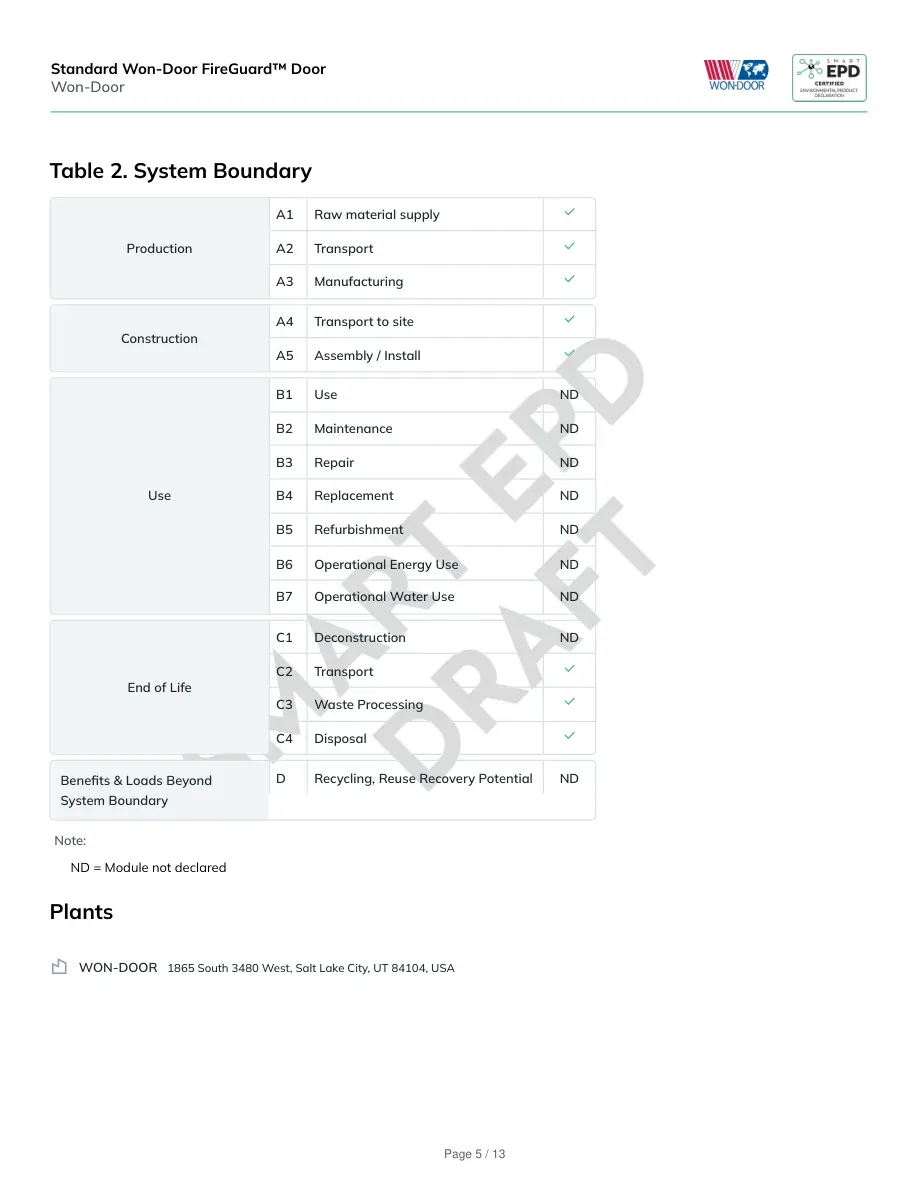
Table 2. System BoundaryProductionA1Raw material supplyA2TransportA3ManufacturingConstructionA4Transport to siteA5Assembly / InstallUseB1UseNDB2MaintenanceNDB3RepairNDB4ReplacementNDB5RefurbishmentNDB6Operational Energy UseNDB7Operational Water UseNDEnd of LifeC1DeconstructionNDC2TransportC3Waste ProcessingC4DisposalBenefits & Loads BeyondSystem BoundaryDRecycling, Reuse Recovery PotentialNDNote:ND = Module not declaredPlantsWON-DOOR1865 South 3480 West, Salt Lake City, UT 84104, USAStandard Won-Door FireGuard™ DoorWon-DoorPage 5 / 13
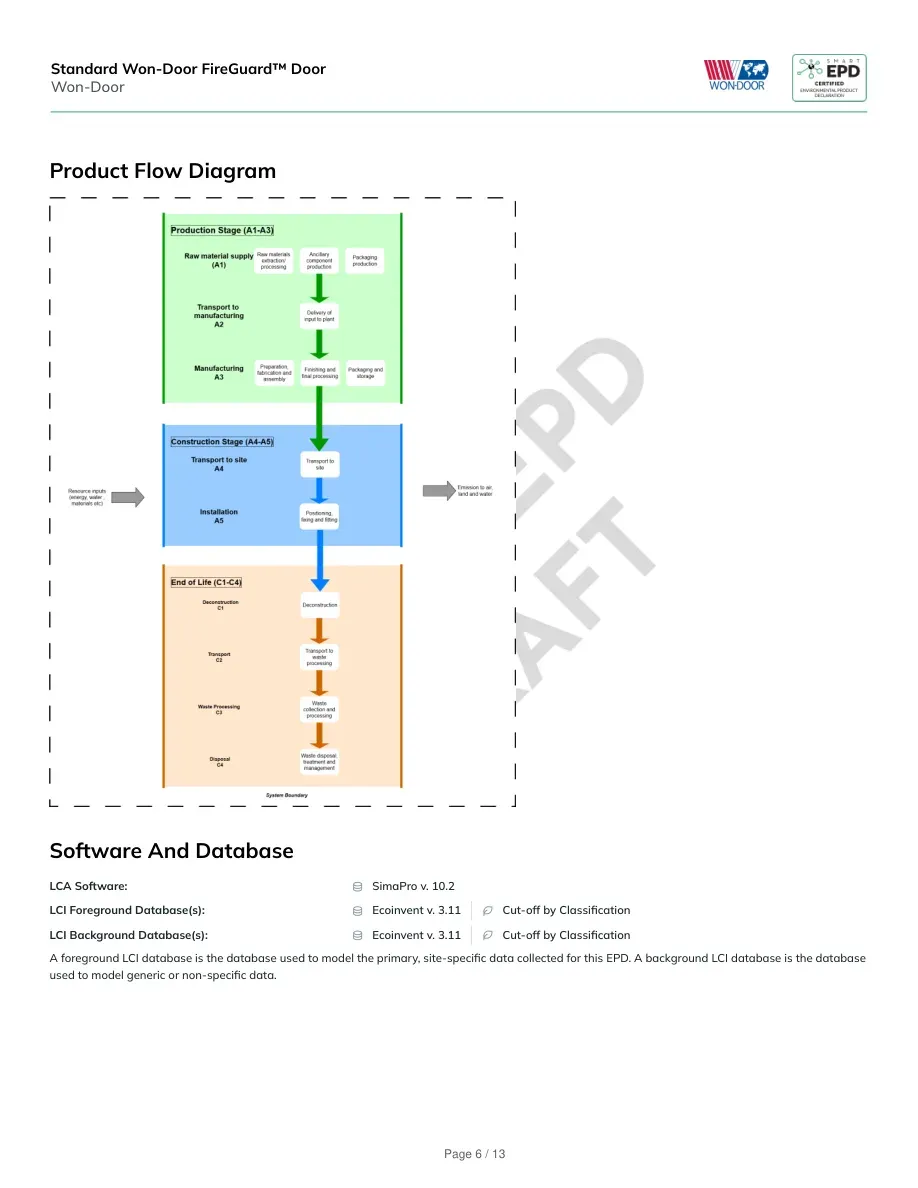
Product Flow DiagramSoftware And DatabaseLCA Software:SimaPro v. 10.2LCI Foreground Database(s):Ecoinvent v. 3.11Cut-off by ClassificationLCI Background Database(s):Ecoinvent v. 3.11Cut-off by ClassificationA foreground LCI database is the database used to model the primary, site-specific data collected for this EPD. A background LCI database is the databaseused to model generic or non-specific data.Standard Won-Door FireGuard™ DoorWon-DoorPage 6 / 13
Data QualityPrecision & CompletenessPrecision: Inventory data were directly measured, calculated, or conservatively estimated from primary sources using consistent units and QA checks.Background processes from ecoinvent v3 were adopted with their documented uncertainty/precision metadata where available, preserving atransparent record of data quality.Completeness: The product system's mass balance and inventory completeness were thoroughly checked. Some exclusions were made in line with thePCR requirements, such as personnel impacts, R&D activities, business travel, and point-of-sale infrastructure. However, no data were intentionallyomitted.Consistency and ReproducibilityConsistency: Primary data for all modules were consistently gathered aiming at the highest level of detail possible. Background processes weremodeled mainly with the ecoinvent database. The same allocation rules, cut-off criteria, and impact assessment methods were applied throughout,ensuring methodological coherence and consistent data quality across the entire LCA model.Reproducibility: This study ensures reproducibility by providing comprehensive disclosure of input–output data, dataset choices, and modelingapproaches. A knowledgeable third party should be able to approximate the results using the same data and modeling methods.RepresentativenessTemporal: Primary data were collected for a 12-month period representing the 2024 calendar year to ensure the representativeness of post-consumercontent. Secondary data from the ecoinvent v3 database are typically representative of recent years.Geographical: Primary data represent Won-Door's production facility. Where applicable, differences in electric grid mix were considered usingappropriate secondary data. The use of country-specific data ensures high geographical representativeness, and proxy data were only used whencountry-specific data were unavailable.Technological: Both primary and secondary data were tailored to the specific technologies studied, ensuring high technological representativeness.Life Cycle Module DescriptionModules A1–A3: The LCA model covers the production of raw materials and components for commercial steel doors and steel frames (A1), which are thentransported to the manufacturing facility by truck or other relevant modes of transport (A2). The manufacturing stage (A3) begins with receipt of thesematerials, which are cut, formed, welded, finished, and assembled into finished steel doors and frames. When applicable, additional components such asinsulation cores, glazing kits, louvers, vision panels, reinforcements, and hardware preparations are incorporated during fabrication and assembly.Modules A4–A5: Once manufacturing is completed, the finished steel doors and steel frames are transported to the construction site or distribution point andthen to the end user (A4). For installation (A5), material losses associated with installation may be considered where relevant. This module includestreatment of installation waste and disposal of packaging materials generated during delivery and installation.Modules C1–C4 and D: At end of life (C1–C4), the steel doors and steel frames are assumed to be removed from the building, collected, and sent toappropriate waste management processes. Individual material streams, including steel and other ancillary materials, are handled separately for recycling,energy recovery, or disposal as applicable. Loads and benefits beyond the system boundary are considered in Module D, including the potential benefitsassociated with recovery and recycling of steel and the displacement of primary materials.LCA DiscussionAllocation ProcedureAllocation of co-products was avoided, to the extent possible, based on the guidance given in ISO 14044:2006, 4.3. Energy use at the facility level wasallocated by the amount of product produced. The manufacturing process does not consume water or generate wastewater or air emissions, other thanthose from fuel combustion. Solid waste was estimated using packaging masses and material losses and allocated following the polluter pays principle.Standard Won-Door FireGuard™ DoorWon-DoorPage 7 / 13
Cut-off ProcedureThe system boundary was defined based on relevance to the goal of the study. For the raw material (A1) and process related inputs (A3), all availableenergy and material flow data have been included in the model.Renewable ElectricityEnergy Attribute Certificates (EACs) such asRenewable Energy Certificates (RECs) or PowerPurchase Agreements (PPAs) are included in thebaseline reported results:NoScenariosTransport to the building/construction site (A4)A4 ModuleFuel Type:DieselVehicle Type:Truck and TrailerTransport Distance:1540 kmCapacity Utilization:33.0 %Packaging Mass:0.582 kgWeight of products transported:27.2 kgCapacity utilization volume factor:1Assumptions for scenario development:Transport distance includes finished product to distribution center and distribution center to pointof sale.Installation in to the building/construction site (A5)A5 ModuleMass of Packaging Waste Specified by Type:0.582 kgBiogenic Carbon Contained in Packaging (kg C):0.258 kgAssumptions for scenario development:Installation is performed by trained technicians according to manufacturer and nationalstandards. Because units are custom-sized and pre-assembled, zero material loss is assumed.The only A5 input is the disposal of product packaging.End of Life (C1 - C4)C1 - C4 ModulesCollection ProcessCollected with Mixed Construction Waste:26.6 kgRecoveryRecycling:14.3 kgLandfill:11.3 kgStandard Won-Door FireGuard™ DoorWon-DoorPage 8 / 13
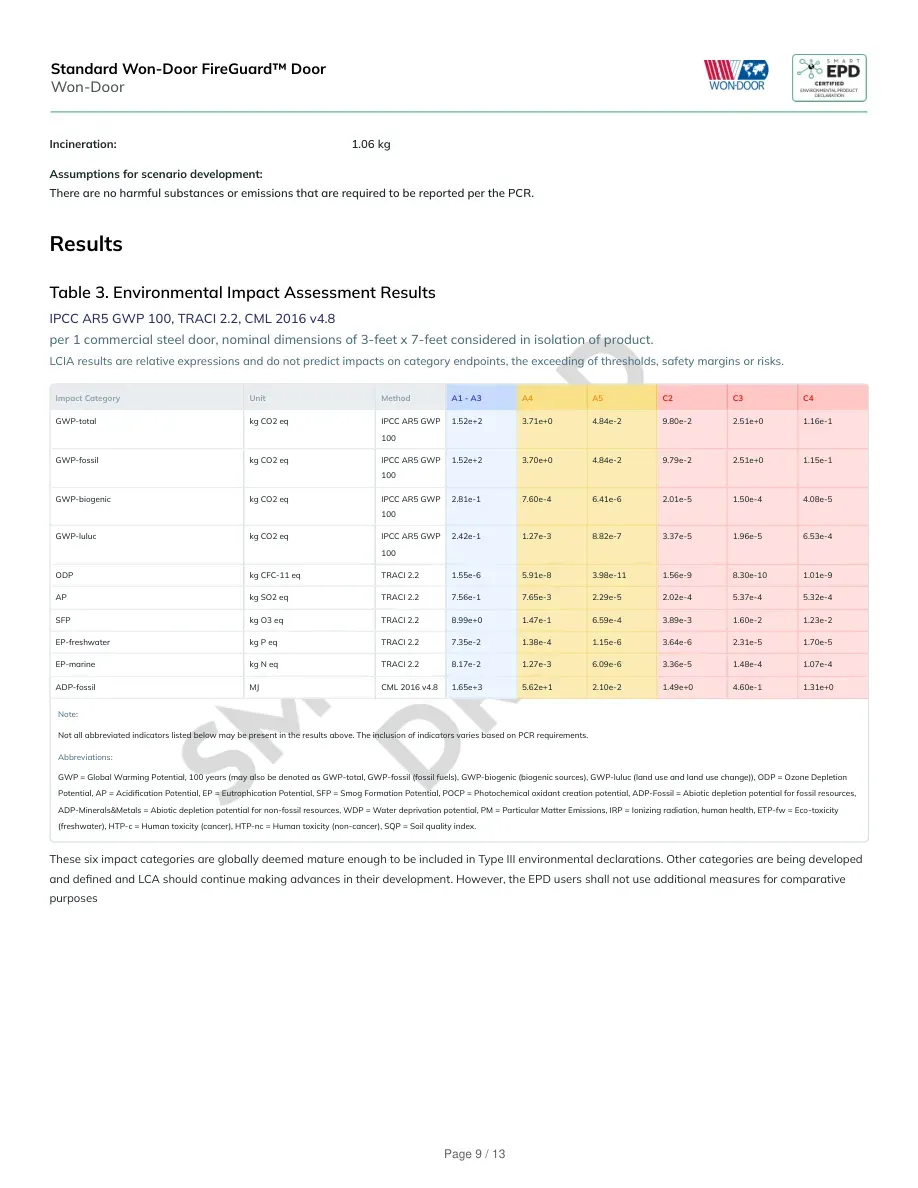
Incineration:1.06 kgAssumptions for scenario development:There are no harmful substances or emissions that are required to be reported per the PCR.ResultsTable 3. Environmental Impact Assessment ResultsIPCC AR5 GWP 100, TRACI 2.2, CML 2016 v4.8per 1 commercial steel door, nominal dimensions of 3-feet x 7-feet considered in isolation of product.LCIA results are relative expressions and do not predict impacts on category endpoints, the exceeding of thresholds, safety margins or risks.Impact CategoryUnitMethodA1 - A3A4A5C2C3C4GWP-totalkg CO2 eqIPCC AR5 GWP1001.52e+23.71e+04.84e-29.80e-22.51e+01.16e-1GWP-fossilkg CO2 eqIPCC AR5 GWP1001.52e+23.70e+04.84e-29.79e-22.51e+01.15e-1GWP-biogenickg CO2 eqIPCC AR5 GWP1002.81e-17.60e-46.41e-62.01e-51.50e-44.08e-5GWP-luluckg CO2 eqIPCC AR5 GWP1002.42e-11.27e-38.82e-73.37e-51.96e-56.53e-4ODPkg CFC-11 eqTRACI 2.21.55e-65.91e-83.98e-111.56e-98.30e-101.01e-9APkg SO2 eqTRACI 2.27.56e-17.65e-32.29e-52.02e-45.37e-45.32e-4SFPkg O3 eqTRACI 2.28.99e+01.47e-16.59e-43.89e-31.60e-21.23e-2EP-freshwaterkg P eqTRACI 2.27.35e-21.38e-41.15e-63.64e-62.31e-51.70e-5EP-marinekg N eqTRACI 2.28.17e-21.27e-36.09e-63.36e-51.48e-41.07e-4ADP-fossilMJCML 2016 v4.81.65e+35.62e+12.10e-21.49e+04.60e-11.31e+0Note:Not all abbreviated indicators listed below may be present in the results above. The inclusion of indicators varies based on PCR requirements.Abbreviations:GWP = Global Warming Potential, 100 years (may also be denoted as GWP-total, GWP-fossil (fossil fuels), GWP-biogenic (biogenic sources), GWP-luluc (land use and land use change)), ODP = Ozone DepletionPotential, AP = Acidification Potential, EP = Eutrophication Potential, SFP = Smog Formation Potential, POCP = Photochemical oxidant creation potential, ADP-Fossil = Abiotic depletion potential for fossil resources,ADP-Minerals&Metals = Abiotic depletion potential for non-fossil resources, WDP = Water deprivation potential, PM = Particular Matter Emissions, IRP = Ionizing radiation, human health, ETP-fw = Eco-toxicity(freshwater), HTP-c = Human toxicity (cancer), HTP-nc = Human toxicity (non-cancer), SQP = Soil quality index.These six impact categories are globally deemed mature enough to be included in Type III environmental declarations. Other categories are being developedand defined and LCA should continue making advances in their development. However, the EPD users shall not use additional measures for comparativepurposesStandard Won-Door FireGuard™ DoorWon-DoorPage 9 / 13
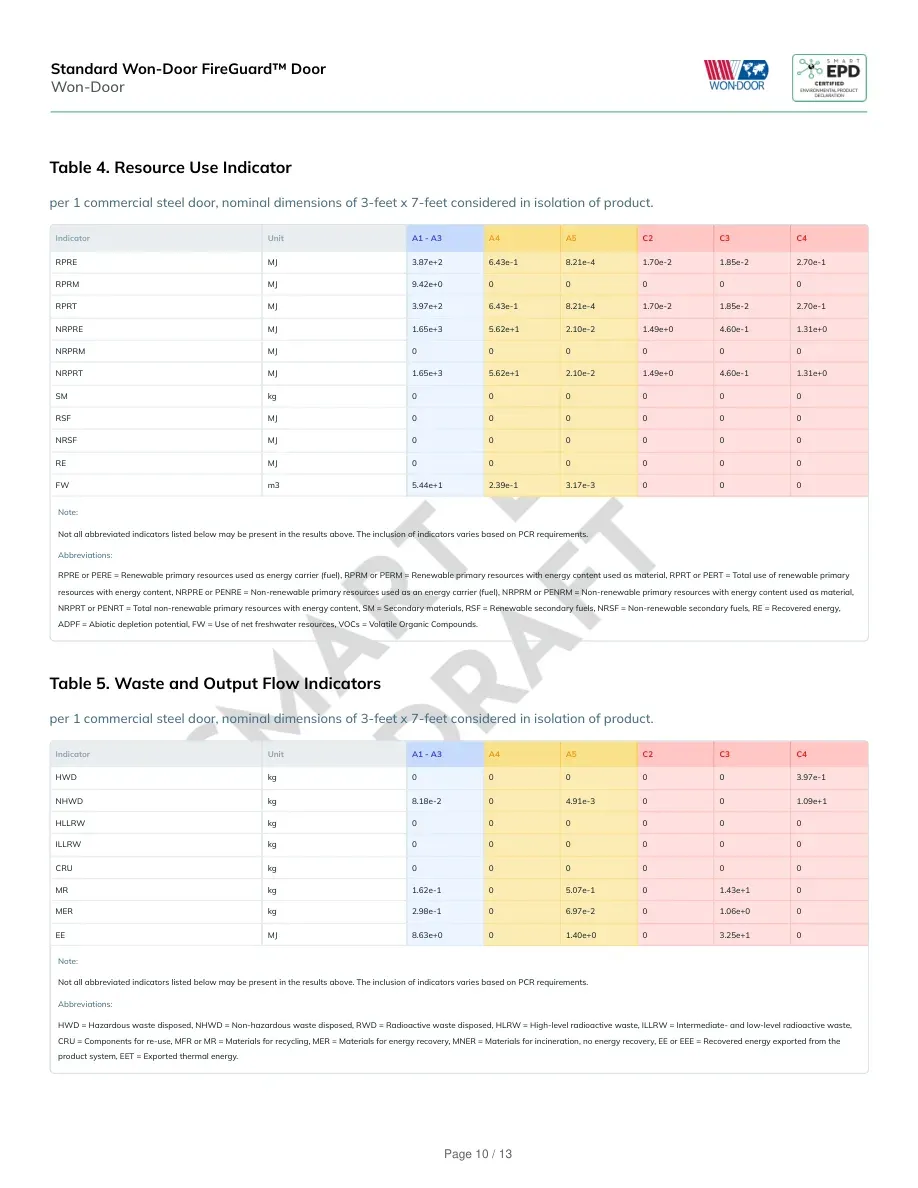
Table 4. Resource Use Indicatorper 1 commercial steel door, nominal dimensions of 3-feet x 7-feet considered in isolation of product.IndicatorUnitA1 - A3A4A5C2C3C4RPREMJ3.87e+26.43e-18.21e-41.70e-21.85e-22.70e-1RPRMMJ9.42e+000000RPRTMJ3.97e+26.43e-18.21e-41.70e-21.85e-22.70e-1NRPREMJ1.65e+35.62e+12.10e-21.49e+04.60e-11.31e+0NRPRMMJ000000NRPRTMJ1.65e+35.62e+12.10e-21.49e+04.60e-11.31e+0SMkg000000RSFMJ000000NRSFMJ000000REMJ000000FWm35.44e+12.39e-13.17e-3000Note:Not all abbreviated indicators listed below may be present in the results above. The inclusion of indicators varies based on PCR requirements.Abbreviations:RPRE or PERE = Renewable primary resources used as energy carrier (fuel), RPRM or PERM = Renewable primary resources with energy content used as material, RPRT or PERT = Total use of renewable primaryresources with energy content, NRPRE or PENRE = Non-renewable primary resources used as an energy carrier (fuel), NRPRM or PENRM = Non-renewable primary resources with energy content used as material,NRPRT or PENRT = Total non-renewable primary resources with energy content, SM = Secondary materials, RSF = Renewable secondary fuels, NRSF = Non-renewable secondary fuels, RE = Recovered energy,ADPF = Abiotic depletion potential, FW = Use of net freshwater resources, VOCs = Volatile Organic Compounds.Table 5. Waste and Output Flow Indicatorsper 1 commercial steel door, nominal dimensions of 3-feet x 7-feet considered in isolation of product.IndicatorUnitA1 - A3A4A5C2C3C4HWDkg000003.97e-1NHWDkg8.18e-204.91e-3001.09e+1HLLRWkg000000ILLRWkg000000CRUkg000000MRkg1.62e-105.07e-101.43e+10MERkg2.98e-106.97e-201.06e+00EEMJ8.63e+001.40e+003.25e+10Note:Not all abbreviated indicators listed below may be present in the results above. The inclusion of indicators varies based on PCR requirements.Abbreviations:HWD = Hazardous waste disposed, NHWD = Non-hazardous waste disposed, RWD = Radioactive waste disposed, HLRW = High-level radioactive waste, ILLRW = Intermediate- and low-level radioactive waste,CRU = Components for re-use, MFR or MR = Materials for recycling, MER = Materials for energy recovery, MNER = Materials for incineration, no energy recovery, EE or EEE = Recovered energy exported from theproduct system, EET = Exported thermal energy.Standard Won-Door FireGuard™ DoorWon-DoorPage 10 / 13
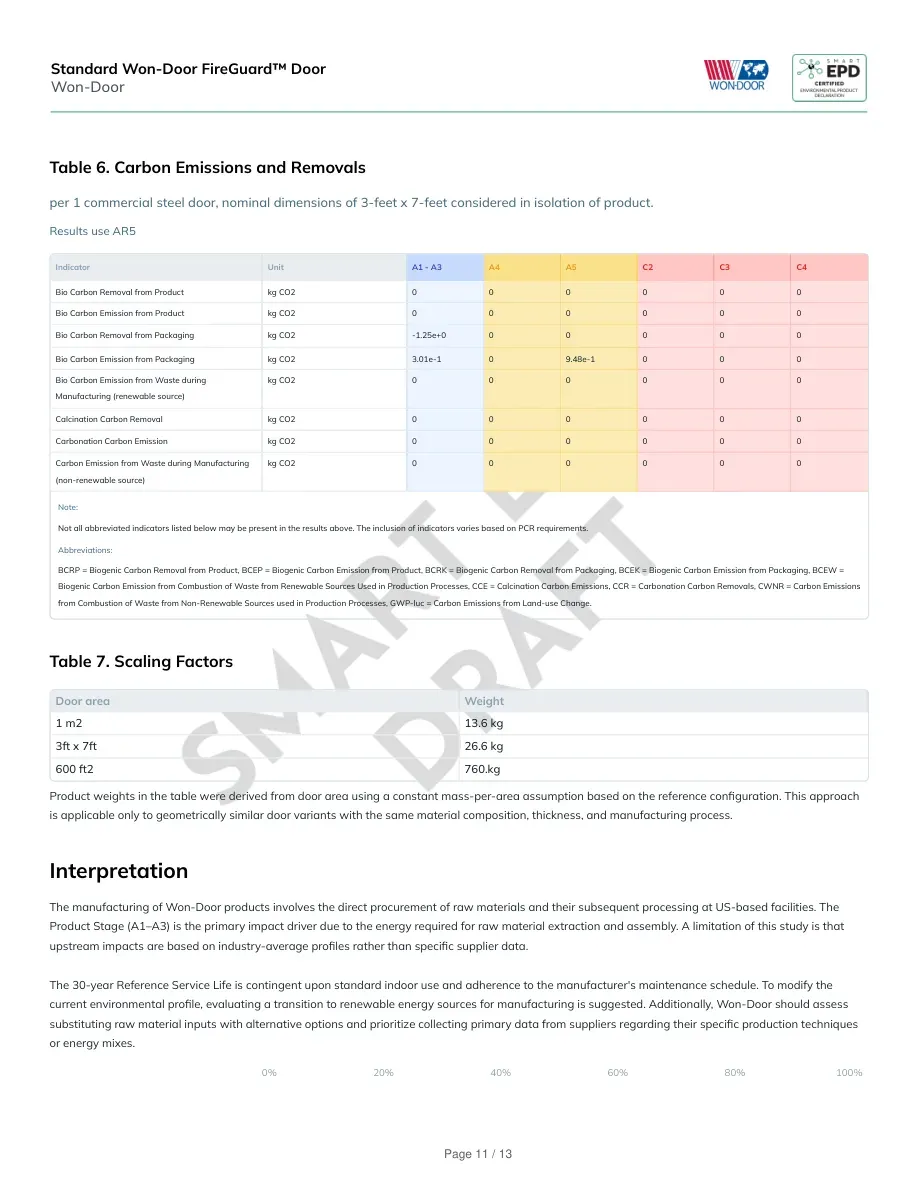
Table 6. Carbon Emissions and Removalsper 1 commercial steel door, nominal dimensions of 3-feet x 7-feet considered in isolation of product.Results use AR5IndicatorUnitA1 - A3A4A5C2C3C4Bio Carbon Removal from Productkg CO2000000Bio Carbon Emission from Productkg CO2000000Bio Carbon Removal from Packagingkg CO2-1.25e+000000Bio Carbon Emission from Packagingkg CO23.01e-109.48e-1000Bio Carbon Emission from Waste duringManufacturing (renewable source)kg CO2000000Calcination Carbon Removalkg CO2000000Carbonation Carbon Emissionkg CO2000000Carbon Emission from Waste during Manufacturing(non-renewable source)kg CO2000000Note:Not all abbreviated indicators listed below may be present in the results above. The inclusion of indicators varies based on PCR requirements.Abbreviations:BCRP = Biogenic Carbon Removal from Product, BCEP = Biogenic Carbon Emission from Product, BCRK = Biogenic Carbon Removal from Packaging, BCEK = Biogenic Carbon Emission from Packaging, BCEW =Biogenic Carbon Emission from Combustion of Waste from Renewable Sources Used in Production Processes, CCE = Calcination Carbon Emissions, CCR = Carbonation Carbon Removals, CWNR = Carbon Emissionsfrom Combustion of Waste from Non-Renewable Sources used in Production Processes, GWP-luc = Carbon Emissions from Land-use Change.Table 7. Scaling FactorsDoor areaWeight1 m213.6 kg3ft x 7ft26.6 kg600 ft2760.kgProduct weights in the table were derived from door area using a constant mass-per-area assumption based on the reference configuration. This approachis applicable only to geometrically similar door variants with the same material composition, thickness, and manufacturing process.InterpretationThe manufacturing of Won-Door products involves the direct procurement of raw materials and their subsequent processing at US-based facilities. TheProduct Stage (A1–A3) is the primary impact driver due to the energy required for raw material extraction and assembly. A limitation of this study is thatupstream impacts are based on industry-average profiles rather than specific supplier data.The 30-year Reference Service Life is contingent upon standard indoor use and adherence to the manufacturer's maintenance schedule. To modify thecurrent environmental profile, evaluating a transition to renewable energy sources for manufacturing is suggested. Additionally, Won-Door should assesssubstituting raw material inputs with alternative options and prioritize collecting primary data from suppliers regarding their specific production techniquesor energy mixes.0%20%40%60%80%100%Standard Won-Door FireGuard™ DoorWon-DoorPage 11 / 13
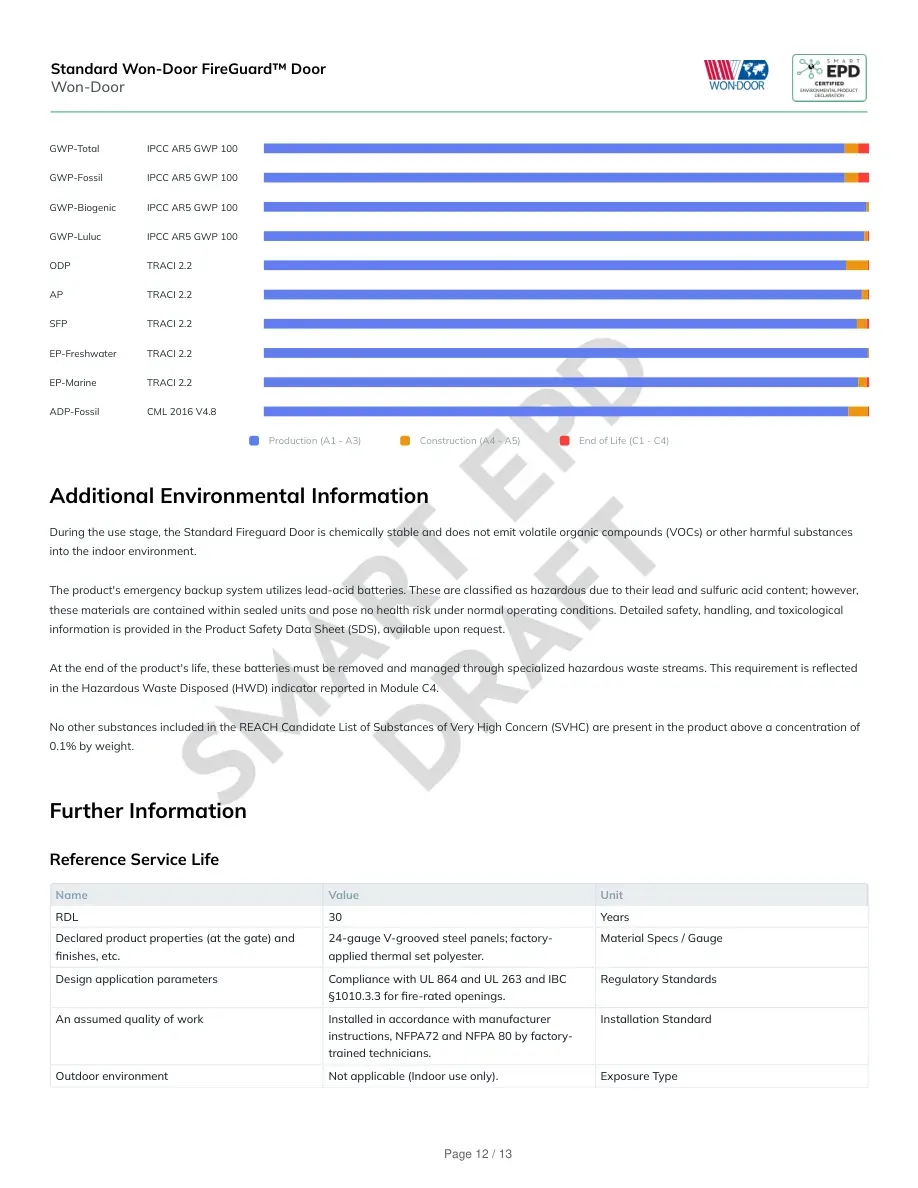
GWP-TotalIPCC AR5 GWP 100GWP-FossilIPCC AR5 GWP 100GWP-BiogenicIPCC AR5 GWP 100GWP-LulucIPCC AR5 GWP 100ODPTRACI 2.2APTRACI 2.2SFPTRACI 2.2EP-FreshwaterTRACI 2.2EP-MarineTRACI 2.2ADP-FossilCML 2016 V4.8Production (A1 - A3)Construction (A4 - A5)End of Life (C1 - C4)Additional Environmental InformationDuring the use stage, the Standard Fireguard Door is chemically stable and does not emit volatile organic compounds (VOCs) or other harmful substancesinto the indoor environment.The product's emergency backup system utilizes lead-acid batteries. These are classified as hazardous due to their lead and sulfuric acid content; however,these materials are contained within sealed units and pose no health risk under normal operating conditions. Detailed safety, handling, and toxicologicalinformation is provided in the Product Safety Data Sheet (SDS), available upon request.At the end of the product's life, these batteries must be removed and managed through specialized hazardous waste streams. This requirement is reflectedin the Hazardous Waste Disposed (HWD) indicator reported in Module C4.No other substances included in the REACH Candidate List of Substances of Very High Concern (SVHC) are present in the product above a concentration of0.1% by weight.Further InformationReference Service LifeNameValueUnitRDL30YearsDeclared product properties (at the gate) andfinishes, etc.24-gauge V-grooved steel panels; factory-applied thermal set polyester.Material Specs / GaugeDesign application parametersCompliance with UL 864 and UL 263 and IBC§1010.3.3 for fire-rated openings.Regulatory StandardsAn assumed quality of workInstalled in accordance with manufacturerinstructions, NFPA72 and NFPA 80 by factory-trained technicians.Installation StandardOutdoor environmentNot applicable (Indoor use only).Exposure TypeStandard Won-Door FireGuard™ DoorWon-DoorPage 12 / 13
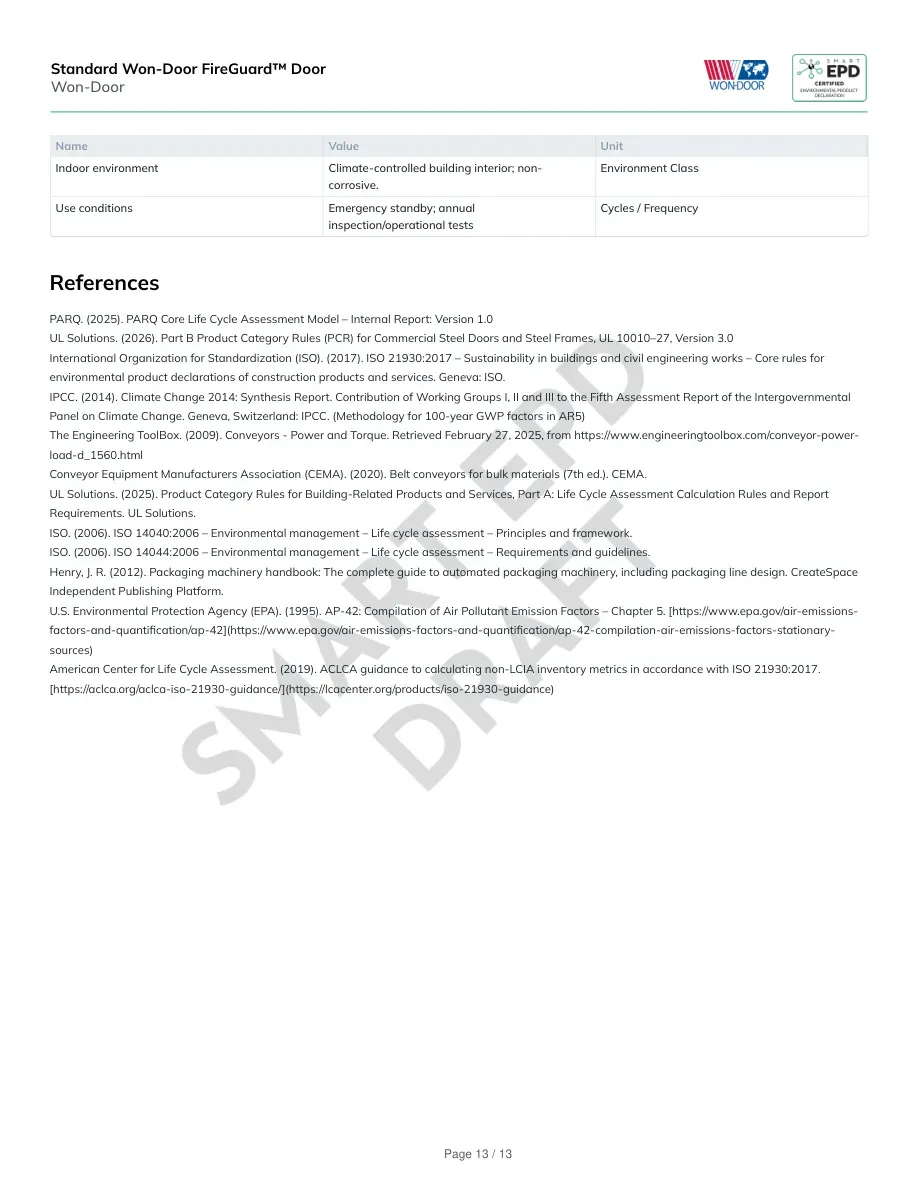
NameValueUnitIndoor environmentClimate-controlled building interior; non-corrosive.Environment ClassUse conditionsEmergency standby; annualinspection/operational testsCycles / FrequencyReferencesPARQ. (2025). PARQ Core Life Cycle Assessment Model – Internal Report: Version 1.0UL Solutions. (2026). Part B Product Category Rules (PCR) for Commercial Steel Doors and Steel Frames, UL 10010–27, Version 3.0International Organization for Standardization (ISO). (2017). ISO 21930:2017 – Sustainability in buildings and civil engineering works – Core rules forenvironmental product declarations of construction products and services. Geneva: ISO.IPCC. (2014). Climate Change 2014: Synthesis Report. Contribution of Working Groups I, II and III to the Fifth Assessment Report of the IntergovernmentalPanel on Climate Change. Geneva, Switzerland: IPCC. (Methodology for 100-year GWP factors in AR5)The Engineering ToolBox. (2009). Conveyors - Power and Torque. Retrieved February 27, 2025, from https://www.engineeringtoolbox.com/conveyor-power-load-d_1560.htmlConveyor Equipment Manufacturers Association (CEMA). (2020). Belt conveyors for bulk materials (7th ed.). CEMA.UL Solutions. (2025). Product Category Rules for Building-Related Products and Services, Part A: Life Cycle Assessment Calculation Rules and ReportRequirements. UL Solutions.ISO. (2006). ISO 14040:2006 – Environmental management – Life cycle assessment – Principles and framework.ISO. (2006). ISO 14044:2006 – Environmental management – Life cycle assessment – Requirements and guidelines.Henry, J. R. (2012). Packaging machinery handbook: The complete guide to automated packaging machinery, including packaging line design. CreateSpaceIndependent Publishing Platform.U.S. Environmental Protection Agency (EPA). (1995). AP-42: Compilation of Air Pollutant Emission Factors – Chapter 5. [https://www.epa.gov/air-emissions-factors-and-quantification/ap-42](https://www.epa.gov/air-emissions-factors-and-quantification/ap-42-compilation-air-emissions-factors-stationary-sources)American Center for Life Cycle Assessment. (2019). ACLCA guidance to calculating non-LCIA inventory metrics in accordance with ISO 21930:2017.[https://aclca.org/aclca-iso-21930-guidance/](https://lcacenter.org/products/iso-21930-guidance)Standard Won-Door FireGuard™ DoorWon-DoorPage 13 / 13
